
What Is Structured Cabling?
The Complete Guide to Building a Reliable Communications Network
Imagine trying to run a business where every computer, phone, security camera, Wi-Fi access point, printer, and conference room had its own unique wiring system.
Troubleshooting would be a nightmare.
That’s exactly why structured cabling was created.
Structured cabling is the standardized wiring infrastructure that allows all of a building’s communication systems to work together. Think of it as the nervous system of a modern building—it provides the pathways that carry data, voice, video, and control signals between devices.
Whether you’re constructing a new office, renovating a warehouse, or upgrading an existing facility, a properly designed structured cabling system creates a foundation that can support your technology for years to come.
What Is Structured Cabling?
Structured cabling is an organized system of low-voltage cables, connectors, patch panels, and network equipment that provides a flexible, reliable, and standardized method for connecting communication devices throughout a building.
Instead of installing separate cables every time new technology is added, structured cabling creates a permanent infrastructure that can support many different systems.
Those systems may include:
- Computer networks
- Internet service
- Wi-Fi access points
- VoIP phone systems
- Security cameras
- Access control
- Audio/video systems
- Building automation
- Digital signage
- Smart building technologies
A well-designed structured cabling system allows these technologies to grow and evolve without constantly rewiring the building.
Why Is It Called “Structured” Cabling?
The word structured refers to the organized, standardized way the system is designed.
Every cable:
- Has a specific destination
- Is labeled at both ends
- Follows defined pathways
- Terminates in standardized hardware
- Can be tested and documented
- Is easy to identify years later
Instead of a tangled collection of random cables, structured cabling creates an organized infrastructure that’s easier to maintain, troubleshoot, and expand.
The Basic Components of a Structured Cabling System
1. Telecommunications Room (MDF/IDF)
Every structured cabling system begins with one or more telecommunications rooms.
These rooms house equipment such as:
- Network switches
- Patch panels
- Fiber enclosures
- UPS systems
- Servers
- Internet equipment
- Cable management
A building may have:
- One Main Distribution Frame (MDF)
- Multiple Intermediate Distribution Frames (IDFs)
The MDF typically serves as the central hub, while IDFs distribute connections to different areas or floors.
2. Horizontal Cabling
Horizontal cabling connects the telecommunications room to individual work areas.
Examples include:
- Office wall jacks
- Conference rooms
- Security cameras
- Wireless access points
- Printers
- Digital displays
Today, most horizontal cabling uses Cat6 or Cat6A Ethernet cable.
3. Backbone Cabling
Backbone cabling connects MDFs and IDFs together.
Because these connections often cover longer distances and carry larger amounts of traffic, fiber optic cable is commonly used.
Backbone cabling acts like the interstate highway of the building’s communications network.
4. Work Area Outlets
These are the connection points people see every day.
Examples include:
- Network wall plates
- Floor boxes
- Conference table outlets
- Ceiling outlets for Wi-Fi access points
- Camera connection points
Each outlet is connected by a dedicated home-run cable back to a patch panel.
5. Patch Panels
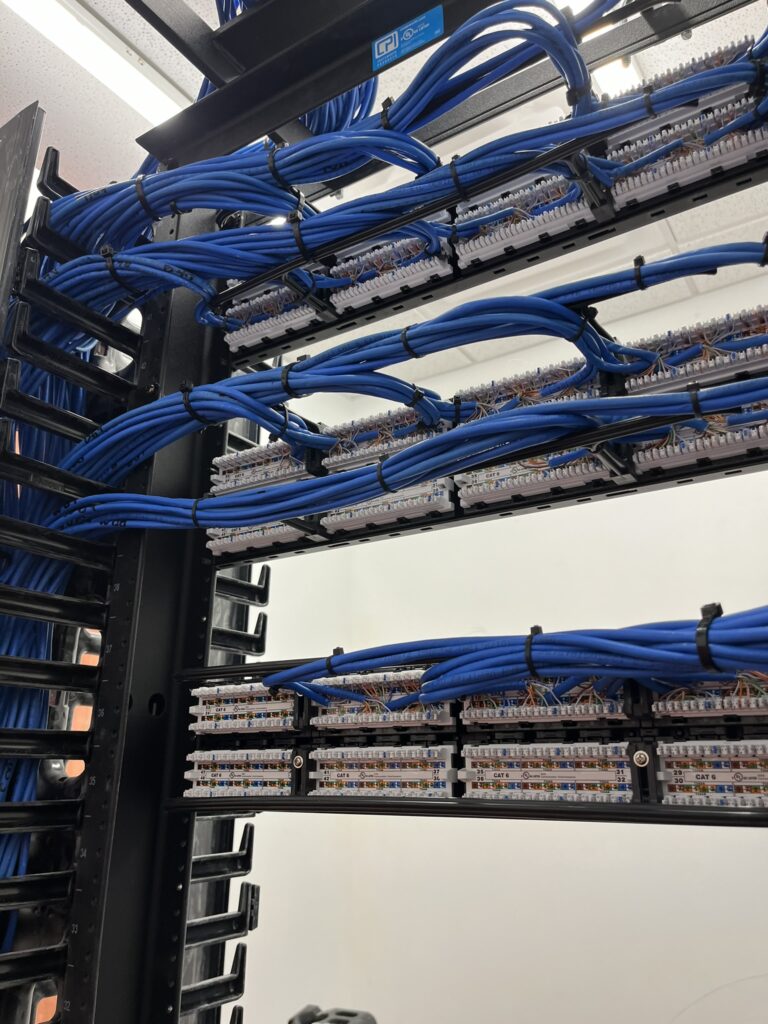
A patch panel is where all permanent cabling terminates inside the rack.
Rather than plugging network cables directly into switches, installers terminate them onto a patch panel and use short patch cords to connect to the switch.
Benefits include:
- Easier maintenance
- Better cable organization
- Reduced wear on permanent cabling
- Faster troubleshooting
- Cleaner rack appearance
- Simpler future upgrades
6. Network Switches
Switches connect all network devices together.
They direct data between:
- Computers
- Servers
- Cameras
- Phones
- Wireless access points
- Printers
- Building systems
Many modern switches also provide Power over Ethernet (PoE), allowing devices to receive both data and electrical power through the same cable.
Common Cable Types
Most structured cabling systems use one or more of the following:
Cat5e
Still found in many existing buildings and suitable for many Gigabit Ethernet applications.
Cat6
Today’s most common choice for commercial installations.
Supports higher performance than Cat5e and provides additional headroom for future growth.
Cat6A
Designed for higher bandwidth applications and longer 10 Gigabit Ethernet runs.
Often selected for new commercial construction and environments where long-term scalability is important.
Fiber Optic Cable
Used between telecommunications rooms, buildings, and high-speed network equipment.
Offers exceptional bandwidth, long transmission distances, and immunity to electromagnetic interference.
Why Good Cable Management Matters
A network may function with messy wiring—but that doesn’t make it a professional installation.
Good cable management provides:
- Easier troubleshooting
- Better airflow
- Faster upgrades
- Reduced strain on cables
- Improved reliability
- A cleaner appearance
- Better documentation
Professional installers use cable managers, Velcro straps, proper bend radiuses, labeling systems, and organized routing to create racks that remain serviceable for years.
Benefits of Structured Cabling
A properly installed structured cabling system offers significant long-term advantages.
Reliability
Standardized installations reduce failures and simplify repairs.
Flexibility
Technology changes, but the underlying infrastructure can often remain in place.
Scalability
Adding new devices becomes much easier when spare capacity and organized pathways already exist.
Easier Troubleshooting
Clear labeling and documentation help technicians identify problems quickly.
Lower Lifetime Costs
While quality installations may cost more initially, they often save substantial labor and replacement costs over the life of the building.
Common Mistakes
Even quality equipment can’t overcome poor installation practices.
Some of the most common mistakes include:
- Running cables without labels
- Exceeding maximum cable lengths
- Damaging cables during installation
- Mixing data cables with high-voltage wiring
- Over-tightening cable bundles
- Ignoring bend radius requirements
- Skipping cable testing and certification
- Connecting permanent cables directly to switches instead of using patch panels
Avoiding these mistakes helps create a network that’s easier to maintain and more reliable over the long term.
Frequently Asked Questions
How long does structured cabling last?
A professionally installed structured cabling system can often remain in service for 15 to 20 years or more, depending on the cable category, installation quality, and future bandwidth requirements.
Can existing cabling be reused?
Sometimes. Older cable may still support current applications, but upgrades are often recommended when expanding a network or planning for future technology.
Is structured cabling only for computers?
No. Modern structured cabling supports many different systems, including phones, Wi-Fi, cameras, access control, audio/video equipment, and building automation.
What’s the difference between Cat6 and fiber?
Cat6 uses copper conductors and is commonly used for connections throughout a building. Fiber optic cable uses light instead of electricity, making it ideal for longer distances and very high bandwidth applications.
Do security cameras use structured cabling?
Most modern IP security cameras connect through a structured cabling system using Ethernet cable, often powered by PoE.
Final Thoughts
Structured cabling is much more than a collection of network cables. It’s the foundation that allows modern technology to work together efficiently.
When installed correctly, it creates an organized infrastructure that’s reliable, easy to expand, and prepared for future technologies. Whether you’re supporting a small office or a large commercial campus, investing in a well-designed structured cabling system helps reduce downtime, simplify maintenance, and protect your technology investment.
In short, a building is only as capable as the infrastructure behind it—and structured cabling is that infrastructure.
Continue Learning
Expand your knowledge with these guides:
- What Is Low Voltage?
- Cat5e vs. Cat6 vs. Cat6A
- What Is Power over Ethernet (PoE)?
- Understanding Fiber Optic Cable
- How Network Switches Work
- What Is a Patch Panel?
- How to Build a Professional Network Rack
- Understanding Wi-Fi Networks